Easy Care Indoor Plants:
- Snake Plant
- ZZ Plant
- Pothos
- Spider Plant
- Aloe Vera
Easy care indoor plants are houseplants that can survive inconsistent care, including low light, infrequent watering, and typical indoor environments.
Most people don’t struggle with plants because they lack skill—they struggle because they choose the wrong ones for their home. The truth is, many “easy” plants still fail when light, watering habits, and environment don’t match. In this guide, you’ll find easy care indoor plants that actually work in real-life conditions, plus how to choose the right one based on your space and routine so you can keep it alive long-term.
💡If you’re new, start with this complete indoor plant care guide for beginners to understand the basics.
In This Article
What Makes a Plant “Easy Care”? (The 3-Factor System)
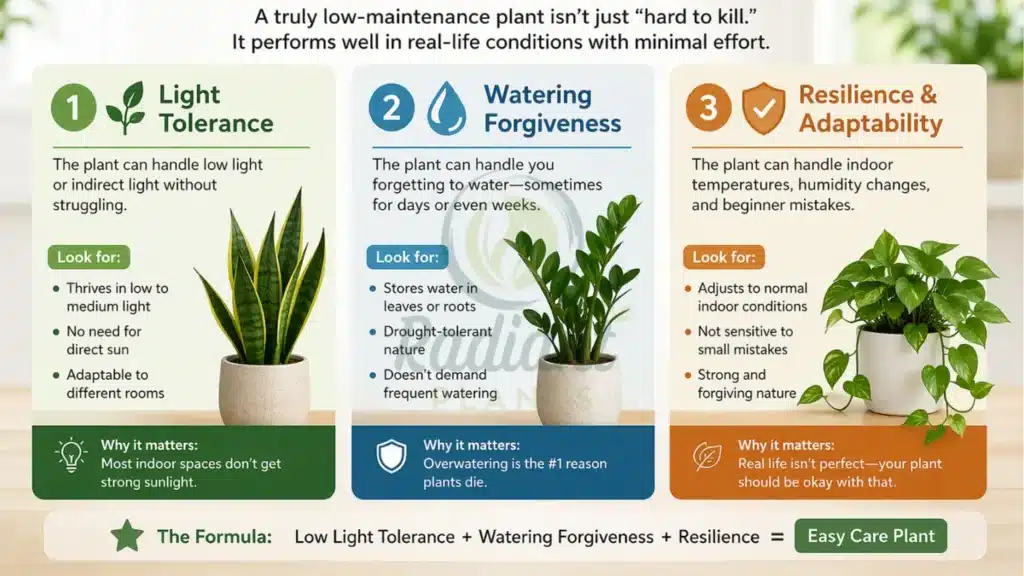
Easy care indoor plants are species that tolerate imperfect conditions—low or inconsistent light, irregular watering, and common beginner mistakes—without declining quickly. In practice, “easy” doesn’t mean zero care; it means the plant is forgiving when your routine isn’t perfect.
Most people assume a plant is easy because it “needs less attention.” That’s only part of the story. What actually determines whether a plant survives in your home comes down to three core factors:
🌿 The 3-Factor Easy Plant System
1. Light Flexibility
A truly easy plant can adapt to less-than-ideal lighting.
- Handles low light or indirect light without a rapid decline
- Doesn’t require precise sun exposure
- Maintains stable growth even in apartments or shaded rooms
👉 Example:
ZZ Plant thrives in low light because it stores energy in thick rhizomes, allowing it to survive darker conditions.
💡 Real-world scenario:
If your room has one window and most of the day feels dim, plants without light flexibility will stretch, weaken, and eventually fail—even if you water them correctly.
⚠️ Common mistake:
Putting a “low light” plant in a no-light corner.
Low light ≠ No light.
2. Water Tolerance
This is where most beginners fail.
Easy care plants can handle:
- Missed watering (underwatering)
- Occasional overwatering without immediate damage
👉 Example:
Snake Plant stores water in its thick leaves, making it extremely drought-tolerant.
💡 What actually works:
Plants with built-in water storage (succulents, thick leaves, rhizomes) are far more forgiving than thin-leaf tropical plants.
⚠️ What often fails:
“Watering on a schedule” instead of checking soil moisture.
This is the #1 cause of indoor plant death—leading to root rot.
3. Recovery Ability
The most overlooked factor—and the biggest difference between “easy” and “fragile.”
An easy plant:
- Recovers from stress (missed watering, wrong light)
- Produces new growth quickly
- Doesn’t collapse after small mistakes
👉 Example:
Pothos can wilt dramatically when dry, but often bounces back within hours after watering.
💡 At Radiant Plants, we’ve found:
Recovery ability is what saves beginners. You will make mistakes—but resilient plants give you time to correct them.
✅ Easy Care Plant Checklist
Use this quick checklist before choosing a plant:
- Can it tolerate low or indirect light?
- Can it survive missed watering?
- Does it recover quickly from stress?
- Does it grow steadily without precise conditions?
👉 If a plant meets at least 2 out of 3 factors, it’s beginner-friendly.
🌱 Expert Insight Most Articles Miss
Many “easy plant” lists ignore why plants fail in real homes.
The truth:
- Most plants don’t die from neglect
- They die from a mismatch (wrong light + wrong watering pattern)
💡 Example:
A succulent is often labeled “easy,” but in a low-light apartment, it becomes weak and eventually dies.
Meanwhile, a ZZ Plant in the same space thrives with almost no effort.
If you’re unsure about your lighting conditions, check our guide on the Best Low Light Indoor House Plants for Beginners to avoid choosing the wrong plant for your space.
Understanding these three factors changes everything. Instead of guessing, you’re choosing plants based on how they actually behave in your environment—and that’s what makes the difference between constant failure and long-term success.
15 Easy Care Indoor Plants (Grouped by Real-Life Situations)
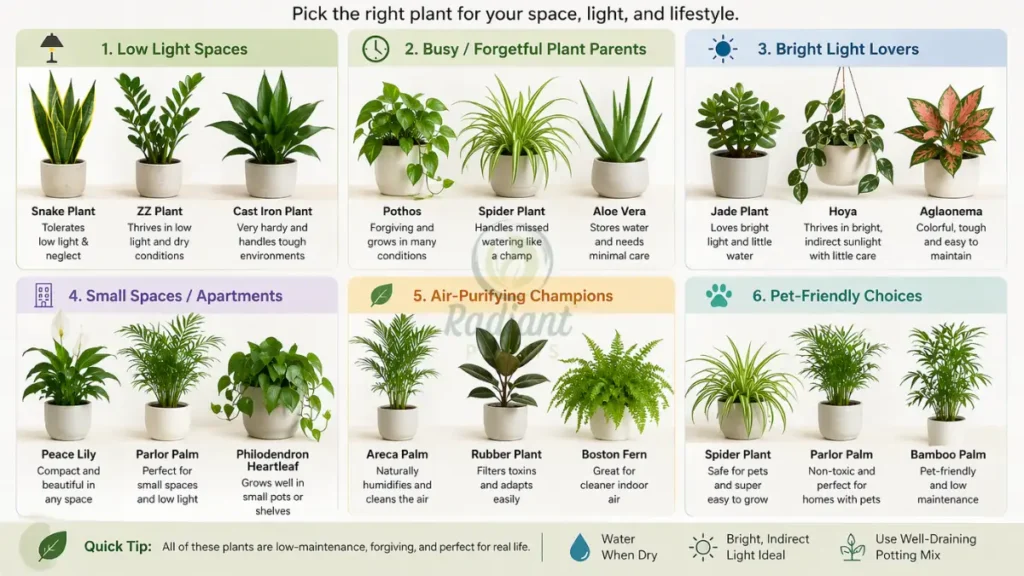
The best easy care indoor plants aren’t just “low maintenance”—they’re the ones that match your actual home conditions and habits. Instead of picking randomly, choose based on your light, watering style, and lifestyle, so the plant works with you, not against you.
Below are the most reliable options, grouped by real-life situations most beginners face.
🌑 Best for Low Light Homes
If your space has limited sunlight (north-facing window, small apartment, or shaded room), you need plants that tolerate low light without weakening quickly.
🌿 ZZ Plant
- Why it’s easy: Stores water in thick roots (rhizomes), survives neglect
- Light needs: Low to bright indirect light
- Water tolerance: Very high (can go weeks without watering)
- Best for: Dark rooms, offices, low-light apartments
Struggling with ZZ Plant Care? Here’s Everything You Need to Know
💡 What actually works:
Place it a few feet from a window—not in a dark corner. Even though plants need some light.
🌿 Snake Plant
- Why it’s easy: Extremely drought-tolerant and adaptable
- Light needs: Low to bright light
- Water tolerance: Very high
- Best for: Beginners who want a nearly indestructible plant
⚠️ Common mistake:
Overwatering. This plant dies more often from too much care than neglect.
🌿 Cast Iron Plant
- Why it’s easy: Built to survive neglect and poor conditions
- Light needs: Low light preferred
- Water tolerance: Moderate to high
- Best for: Older homes, shaded interiors
💡 Insight competitors miss:
This plant grows slowly, which is actually a benefit—it’s less sensitive to environmental changes.
💧 Best for Forgetful Watering
If you often forget to water (or travel frequently), these plants can handle dry soil without crashing.
🌿 Aloe Vera
- Why it’s easy: Stores water in thick leaves (succulent behavior)
- Light needs: Bright indirect to direct light
- Water tolerance: Very high (drought-tolerant)
- Best for: Sunny windows, minimal care routines
💡 Real scenario:
If your plant sits near a sunny kitchen window and you water every 2–3 weeks, Aloe thrives.
⚠️ What often fails:
Putting Aloe in low light—this causes stretching and weak growth.
🌿 Snake Plant
- Why it’s easy: Handles both drought and irregular care
- Light needs: Flexible
- Water tolerance: Very high
- Best for: People who forget to water completely
🌿 Jade Plant
- Why it’s easy: Succulent leaves store water efficiently
- Light needs: Bright light
- Water tolerance: High
- Best for: Sunny rooms and minimal watering schedules
🌱 Fast-Growing & Forgiving
These plants are perfect if you want visible growth and quick recovery from mistakes.
🌿 Pothos
- Why it’s easy: Extremely adaptable and fast-growing
- Light needs: Low to bright indirect light
- Water tolerance: Moderate to high
- Best for: Beginners who want quick results
💡 At Radiant Plants, we’ve found:
Pothos is one of the few plants that clearly “tells” you when it needs water—leaves droop slightly, then recover fast.
🌿 Spider Plant
- Why it’s easy: Fast grower with strong recovery ability
- Light needs: Bright indirect light
- Water tolerance: Moderate
- Best for: Hanging baskets, small spaces
💡 What actually works:
Even if you forget watering once, it bounces back quickly—great for building confidence.
🪴 Stylish but Easy
If you want plants that look impressive but don’t require expert care, these strike the balance.
🌿 Monstera
- Why it’s easy: Tolerates indoor conditions well
- Light needs: Bright indirect light
- Water tolerance: Moderate
- Best for: Living rooms, statement decor
Choosing a Monstera? Here Are the Best Varieties for Your Home
⚠️ Beginner mistake:
Too little light = no leaf splits (“fenestrations”).
This isn’t a watering issue—it’s a light problem.
🌿 Rubber Plant
- Why it’s easy: Thick leaves reduce water sensitivity
- Light needs: Bright indirect light
- Water tolerance: Moderate
- Best for: Clean, modern interiors
Struggling with Your Rubber Plant? Tips to Keep It Healthy Indoors
💡 Insight:
Rubber plants are more forgiving than they look—but hate sudden environmental changes (drafts, temperature swings).
If you’re unsure whether your home qualifies as “low light,” check our guide on the Best Low Light Indoor House Plants to avoid choosing the wrong category.
🌦️ Seasonal Note
In winter, even “bright” rooms can behave like low-light environments due to shorter days.
👉 This is why plants like ZZ Plant and Snake Plant often perform better during colder months.
🧠 Key Takeaway (What Most People Miss)
The plant itself isn’t the problem—the mismatch is.
- Low light home + succulent → failure
- Forgetful watering + tropical plant → stress
- Right match → long-term success with minimal effort
Choose based on your reality, not the label “easy,” and these plants will actually thrive—even if you forget sometimes.
Why Easy Indoor Plants Still Die (Quick Diagnosis)
Most easy care indoor plants don’t die because they’re “hard”—they die because of a mismatch and misdiagnosis. The three biggest killers are overwatering, low light, and poor drainage, and they often look similar at first, which is why beginners get stuck in a cycle of guessing.
Before you change anything, you need to identify the real cause—not just react.
⚡ Quick Diagnosis Box
Use this to quickly identify what’s going wrong:
- Yellow leaves + soft stems + wet soil → Overwatering (root rot risk)
- Pale, stretched growth + leaning plant → Not enough light
- Soil stays wet for days + no growth → Poor drainage or compacted soil
- Drooping + dry soil → Underwatering (less common than you think)
👉 If you’re unsure, check soil moisture first—this solves 80% of cases.
💧 Overwatering → Root Rot
This is the #1 reason indoor plants die—especially “easy” ones.
What happens:
- Roots sit in constantly wet soil
- Oxygen is blocked
- Roots begin to rot and stop absorbing water
How to recognize it:
- Yellowing leaves (starting from the bottom)
- Mushy stems or base
- Soil feels wet even days after watering
💡 What actually works:
- Let the top 1–2 inches of soil dry before watering
- Use pots with drainage holes
- Empty excess water from saucers
⚠️ Common beginner mistake:
Watering on a fixed schedule (e.g., “every Sunday”) instead of checking the soil.
At Radiant Plants, we’ve found that many beginners double down on watering when leaves turn yellow—making the problem worse.
🌑 Low Light → Weak, Failing Growth
Light is the energy source for your plant. Without enough of it, even the toughest plants slowly decline.
What happens:
- Growth becomes thin and stretched (“leggy”)
- Leaves get smaller or lose color
- The plant leans toward light sources
How to recognize it:
- Long gaps between leaves
- Plant bending toward a window
- No new growth over the weeks
💡 Real home scenario:
Your plant sits in a corner that “looks bright” to your eyes—but plants need significantly more light than humans perceive.
⚠️ Common mistake:
Trying to fix the low light by watering more or adding fertilizer.
👉 This doesn’t work—light is the limiting factor.
🪴 Poor Drainage → Root Suffocation
Even if you water correctly, bad soil or pots can quietly kill your plant.
What happens:
- Water doesn’t drain properly
- Soil stays dense and soggy
- Roots suffocate and weaken
How to recognize it:
- Water pools on top of the soil
- Soil feels heavy and compact
- No visible growth despite “correct” care
💡 What actually works:
- Use a well-draining soil mix (not dense garden soil)
- Always choose pots with drainage holes
- Loosen compacted soil when repotting
⚠️ Warning Box: Why Most Advice Fails
Many guides say:
“Just water less”
That’s incomplete—and often wrong.
👉 The real issue is usually:
- Wrong light + watering combination
- Soil that holds too much moisture
- A plant that doesn’t match your environment
Fixing only watering without addressing light or soil rarely solves the problem.
🧠 Insight Most People Miss
Overwatering and low light often look similar:
- Yellow leaves
- Slow growth
- Weak appearance
👉 The difference:
- Overwatering: the soil is wet
- Low light: soil is often dry, but the plant still struggles
Learning to tell this apart is what separates beginners from confident plant owners.
If you’re unsure how often to water, see our guide on how often to water indoor plants properly to avoid overwatering mistakes.
🌦️ Seasonal Note
In winter, plants use less water because growth slows and light decreases.
👉 This is when overwatering becomes most dangerous—even for “easy” plants.
Once you understand these three causes, plant care stops being guesswork. You’re no longer reacting—you’re diagnosing, which is the real skill behind keeping indoor plants alive.
How to Choose the Right Plant for Your Home
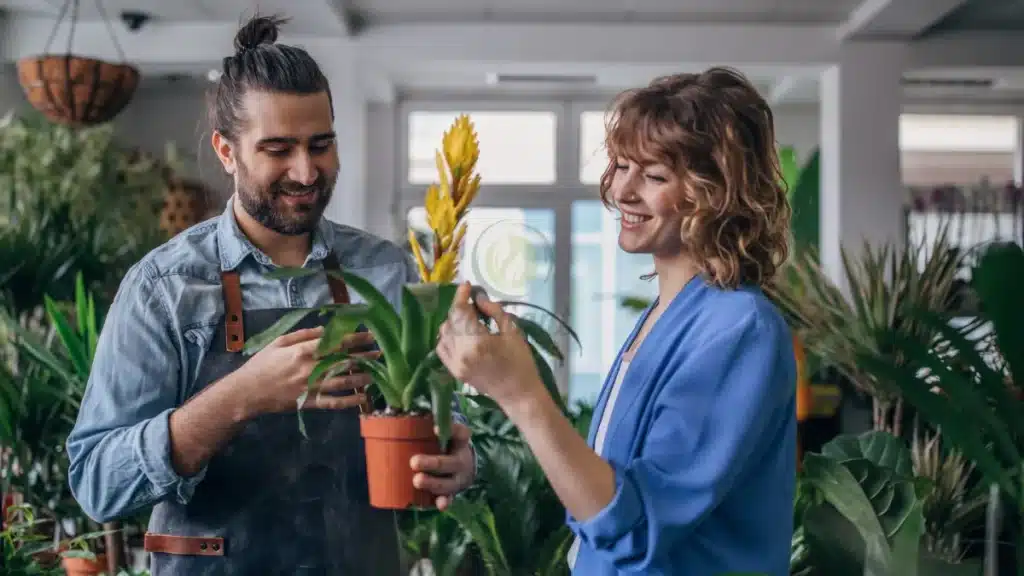
The right easy care indoor plant depends on your light, your habits, and your space—not the plant label. If you match those three correctly, even beginners succeed; if you mismatch them, even “easy” plants fail.
Think of this as a simple decision process: light first, lifestyle second, space third.
☀️ 1) Choose Based on Light (This Matters Most)
Light is the limiting factor—everything else adjusts around it. Start by identifying what your room actually gets, not what it feels like.
Quick guide:
- Low light (north-facing, far from windows): go with ZZ Plant or Snake Plant
- Bright indirect (near a window, no harsh sun): Pothos or Monstera
- Direct sun (south/west window): Aloe Vera or Jade Plant
💡 What actually works:
Stand in your room at midday—if you can comfortably read without turning lights on, you likely have at least moderate light. If it feels dim, treat it as low light.
⚠️ Common mistake:
Choosing a plant first, then trying to “make the space work.”
👉 Always do the opposite.
🧠 2) Choose Based on Your Lifestyle
This is where most advice fails. Your habits matter just as much as your environment.
If you forget watering:
- Choose drought-tolerant plants like Snake Plant or Aloe
- Avoid thin-leaf tropical plants that dry out quickly
If you tend to overwater:
- Choose resilient plants like the ZZ Plant
- Use well-draining soil (see our guide on the best soil mix for indoor plants)
If you travel often:
- Pick slow-growing, low-demand plants
- Avoid fast growers that need regular care
💡 At Radiant Plants, we’ve found:
It’s not about being “good with plants”—it’s about choosing plants that match your habits. People who think they’re bad at plants usually just pick the wrong type.
🏠 3) Choose Based on Your Space
Your available space affects growth, maintenance, and long-term success.
Small spaces/desks:
- Spider Plant
- Compact Pothos
Open living rooms:
- Monstera
- Rubber Plant
Shelves or hanging setups:
- Pothos (trailing)
- Spider Plant
💡 Real scenario:
A Monstera looks amazing in photos, but in a tight apartment corner, it quickly becomes oversized and stressed from lack of light.
✅ Quick Decision Checklist
Before buying any plant, ask:
- Does my space have enough light for this plant?
- Will I realistically water it correctly?
- Does it fit my space as it grows?
- Is it forgiving if I make mistakes?
👉 If you hesitate on any of these, choose a more resilient option.
🧠 Insight Most People Miss
Most failures aren’t about care—they’re about starting wrong.
- Wrong light → slow decline
- Wrong plant for lifestyle → inconsistent care
- Wrong size → long-term stress
👉 When you get the match right, care becomes simple—even if you forget sometimes.
🌦️ Seasonal Note
Light changes dramatically in winter. A spot that works in summer may become low-light later.
👉 If your plant struggles in colder months, it’s often a light issue—not watering.
Choosing the right plant is less about knowledge and more about alignment. Once your plant matches your home and habits, everything else becomes easier—and that’s what makes easy care indoor plants actually work.
Quick Comparison Table (Fast Decision Tool)
If you want the fastest way to choose, focus on plants with high water tolerance + flexible light—those are the easiest overall. For most beginners, Snake Plant and ZZ Plant are the safest starting points.
Plant | Light | Water | Difficulty | Best for |
|---|---|---|---|---|
Snake Plant | Low to bright | Very low | ⭐ Very easy | Forgetful beginners |
ZZ Plant | Low to medium | Very low | ⭐ Very easy | Low-light homes |
Pothos | Low to bright indirect | Moderate | ⭐ Easy | Fast growth + beginners |
Spider Plant | Bright indirect | Moderate | ⭐ Easy | Small spaces, hanging |
Aloe Vera | Bright/direct | Low | ⭐ Easy | Sunny spots, low watering |
Jade Plant | Bright/direct | Low | ⭐ Easy | Minimal care routines |
Monstera | Bright indirect | Moderate | ⭐ Medium | Stylish interiors |
Rubber Plant | Bright indirect | Moderate | ⭐ Medium | Clean, modern spaces |
Cast Iron Plant | Low | Low to moderate | ⭐ Very easy | Dark rooms |
💡 At Radiant Plants, we’ve found:
If you’re unsure, start with Snake Plant or ZZ Plant—they tolerate both low light and watering mistakes better than most.
⚠️ What often fails:
Choosing a plant based on looks (like Monstera) without matching light conditions.
👉 Even “easy care indoor plants” struggle if the light doesn’t match.
🔗 If you’re not sure about your lighting, check the best indoor plants for low light conditions before deciding.
🌦️ Seasonal note:
In winter, light levels drop—plants rated for “bright indirect light” may behave like low-light plants, so watering should be reduced accordingly.
Common Beginner Mistakes (and How to Avoid Them)
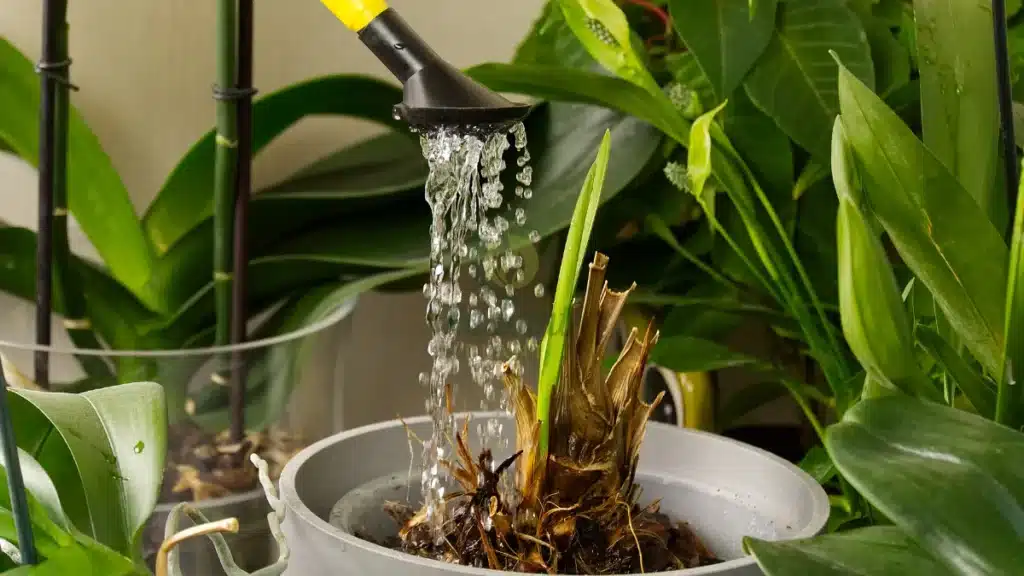
Most easy care indoor plants fail for the same three reasons: too much water, the wrong light, and soil that traps moisture. These mistakes are easy to fix once you know how to recognize them—and more importantly, how to tell them apart.
💧 Overwatering (The #1 Killer)
What beginners do:
- Water on a schedule (“every Sunday”)
- Add water when leaves look weak—without checking the soil
What actually happens:
- Roots sit in wet soil
- Oxygen is blocked
- Roots rot and stop absorbing water
How to tell it’s overwatering (not underwatering):
- Soil is still wet 2–4 days after watering
- Leaves turn yellow and feel soft
- The plant looks droopy despite wet soil
👉 Key difference:
- Overwatering = wet soil + drooping
- Underwatering = dry soil + drooping
💡 What works:
- Stick your finger 1–2 inches into the soil before watering
- Only water when that layer feels dry
- Always use pots with drainage holes
⚠️ At Radiant Plants, we’ve found:
Beginners often increase watering when leaves turn yellow—this accelerates root rot.
Overwatering Plants: 6 Signs You’re Killing Your Plant (and Fixes)
☀️ Wrong Light Placement
What beginners do:
- Place plants based on aesthetics (corner, shelf, decor)
- Assume indoor light is “bright enough”
What actually happens:
- The plant doesn’t get enough energy
- Growth becomes weak, stretched, or stops completely
How to tell it’s a light issue (not watering):
- Long, thin stems (“leggy growth”)
- The plant leans toward a window
- No new growth for weeks
💡 Real scenario:
A Monstera placed in a dim corner won’t develop split leaves—not because of watering, but because of low light.
👉 What works:
- Place plants within a few feet of a window
- Rotate plants occasionally for even growth
- Match plant type to light level (see best indoor plants for low light conditions)
🪴 Using the Wrong Soil (Hidden Problem)
This is the mistake most guides ignore.
What beginners do:
- Use dense, moisture-heavy soil
- Keep plants in the original nursery mix too long
What actually happens:
- Soil holds too much water
- Roots stay wet and suffocate
How to tell it’s a soil problem:
- Soil feels heavy and compact
- Water pools on top before soaking in
- The plant struggles even with correct watering
💡 What works:
- Use a well-draining indoor plant mix
- Add perlite or sand to improve airflow
- Repot if the soil stays wet too long
⚠️ The Big Misdiagnosis Problem
Here’s where most beginners get stuck:
- Yellow leaves → assume underwatering → water more
- Drooping leaves → assume thirst → water again
👉 But often:
- The real issue is overwatering or low light
💡 Insight most people miss:
Symptoms overlap—but soil moisture tells the truth.
🌦️ Seasonal Mistake to Avoid
In winter:
- Light decreases
- Plant growth slows
👉 But many people keep watering the same way.
Result:
- Soil stays wet longer
- Root rot risk increases
🧠 What Actually Works Long-Term
- Check soil before watering (not the calendar)
- Match plant to your light, not your decor
- Use breathable, well-draining soil
Once you fix these three mistakes, easy care indoor plants actually become easy—and stay that way.
Seasonal Care Tips (Quick Adjustments That Matter)
Yes—easy care indoor plants do need different care depending on the season, mainly because light, temperature, and humidity change indoors. The biggest mistake beginners make is keeping the same routine year-round, which often leads to overwatering in winter and stress in summer.
❄️ Winter: Low Light + Slow Growth
In winter, days are shorter, and sunlight is weaker—even bright rooms can behave like low-light spaces.
What changes:
- Plants grow more slowly or pause growth
- Soil dries much more slowly
- Light becomes the limiting factor
What to adjust:
- Water less frequently (soil stays wet longer)
- Move plants closer to windows if possible
- Prioritize low-light-tolerant plants like ZZ Plant or Snake Plant
💡 Real scenario:
A plant that needed water every 7 days in summer may only need it every 2–3 weeks in winter.
⚠️ What often fails:
Watering out of habit instead of checking the soil—this is when root rot becomes most common.
☀️ Summer: Faster Growth + Higher Water Demand
In warmer months, plants receive more light and grow actively.
What changes:
- Faster growth
- Soil dries out quicker
- Higher water demand
What to adjust:
- Check the soil more often (not necessarily water more blindly)
- Expect more frequent watering for fast growers like Pothos
- Watch for direct sun exposure, especially near windows
💡 What actually works:
Instead of increasing watering on a schedule, increase how often you check the soil.
⚠️ Beginner mistake:
Assuming more sun always helps—too much direct sun can burn leaves, especially for plants like Monstera.
💨 Dry Indoor Air (Hidden Year-Round Issue)
Indoor air—especially with heating or air conditioning—can become very dry.
What happens:
- Leaf edges turn brown or crispy
- Plants lose moisture faster
- Growth slows or becomes uneven
How to recognize it:
- Browning tips (especially on tropical plants)
- Soil is drying faster than expected
What to adjust:
- Group plants together to increase local humidity
- Keep plants away from heating vents or AC airflow
- Occasionally mist tropical plants (lightly, not excessively)
💡 At Radiant Plants, we’ve found:
Dry air affects appearance more than survival for most easy care indoor plants—but it’s often mistaken for a watering issue.
🧠 Insight Most People Miss
Seasonal care isn’t about doing more—it’s about adjusting timing and observation.
- Winter problems → usually too much water
- Summer problems → usually too much sun or inconsistent watering
- Dry air problems → often misdiagnosed as watering issues
👉 The key skill isn’t memorizing schedules—it’s noticing how your plant responds as conditions change.
If you’re unsure how to adjust watering throughout the year, see our guide on how often to water indoor plants properly for a more precise approach.
Small seasonal adjustments make a big difference. Once you adapt to these shifts, easy care indoor plants stay healthy year-round—even with a simple routine.
Easy Care Indoor Plants FAQs: Common Questions Answered
What is the easiest indoor plant to keep alive?
The easiest indoor plants are those that tolerate both low light and missed watering. Snake Plant and ZZ Plant are top choices because they store water and adapt well to different environments. If you’re a beginner, start with one of these—they’re very forgiving and don’t need frequent attention.
How often should I water easy care indoor plants?
There’s no fixed schedule—most easy care indoor plants should be watered only when the top 1–2 inches of soil feel dry. In summer, this may be once a week; in winter, every 2–3 weeks. Always check the soil first to avoid overwatering, which is the most common mistake.
Can easy care indoor plants survive in low light?
Yes, but only certain plants truly tolerate low light. ZZ Plant, Snake Plant, and Cast Iron Plant are the best options. Keep in mind that “low light” still means some natural light—completely dark spaces won’t support healthy growth over time.
Why are my indoor plants turning yellow?
Yellow leaves are usually caused by overwatering or poor drainage, not underwatering. Check if the soil is still wet—if it is, reduce watering and improve drainage. If the soil is dry, then watering may be the issue. Correct diagnosis is key to fixing the problem.
Do easy care indoor plants need fertilizer?
Yes, but only during active growth (spring and summer). Use a balanced indoor plant fertilizer once a month. Avoid fertilizing in fall and winter, when growth slows, as this can stress the plant rather than help it.
What is the best indoor plant for beginners?
The best beginner plant is one that matches your environment. For most homes, Snake Plant or Pothos are ideal because they handle different light conditions and recover quickly from mistakes. Choose based on your light and watering habits for the best results.
Choosing easy care indoor plants becomes simple once you match the plant to your light, lifestyle, and space. Focus on forgiving plants, avoid overwatering, and adjust care as conditions change. Start with one or two reliable options, learn how they respond, and build from there. You don’t need perfect routines—just the right setup. If you want to go deeper, explore our full indoor plant care guide to keep your plants healthy long-term.