
Plants for Hanging Baskets: How to Choose the Best Ones
Plants for Hanging Baskets are best chosen by matching the plant’s growth habit, light needs, and climate to where the basket will hang. Trailing or cascading plants that tolerate containers and bloom for long periods consistently perform the best.
Plants for Hanging Baskets succeed when three basics are right: sun exposure, temperature range, and maintenance level. According to container gardening guidelines used across the US and Canada, hanging baskets dry out faster than ground plantings and are more exposed to heat and wind, which makes plant selection more important than planting technique. Garden trials and nursery data consistently show that sun-matched plants last longer, bloom more heavily, and require less replacement during the season.
This guide breaks down Plants for Hanging Baskets in a simple, practical way—by light conditions, climate zones, and care needs—so you can confidently choose plants that stay full, healthy, and attractive from spring through late summer without constant troubleshooting.
Table of Contents
In This Article
What Are the Best Plants for Hanging Baskets?

Plants for hanging baskets perform best when they naturally trail, tolerate limited root space, and bloom consistently over a long season. The most reliable choices are cascading or “spiller” plants that adapt well to containers, handle frequent watering, and stay attractive without constant pruning. When these traits align, baskets stay fuller, healthier, and visually balanced for months rather than weeks.
Snippet-ready answer
Plants for hanging baskets are best when they have a trailing growth habit, tolerate container conditions, and offer long-lasting blooms. Plants that spill over the edges, handle limited root space, and flower continuously provide fuller baskets with less maintenance throughout the growing season.
From a practical standpoint, hanging baskets are a tougher environment than in-ground beds. They dry out faster, experience more wind, and heat up quickly. That’s why plant choice matters more than fertilizer brands or planting tricks. According to container-growing principles outlined by the USDA, plants selected for containers should be matched to exposure and space limitations to avoid stress-related decline.
What makes a plant suitable for hanging baskets?
Not every attractive plant is a good basket plant. The best performers share a few specific characteristics that make them adaptable to suspended containers.
1) Trailing vs. upright growth
Trailing or cascading plants naturally spill over the sides of a basket, creating the classic full, rounded look most gardeners want. Upright plants tend to look sparse unless paired carefully.
Good examples: petunias, calibrachoa, verbena, lobelia
Less suitable alone: tall grasses, rigid-stemmed perennials
University container trials consistently show that trailing plants distribute growth more evenly, reducing the need for frequent reshaping.
2) Root space tolerance
Hanging baskets limit root expansion. Plants that require deep or aggressive root systems often struggle, even with frequent feeding. Container-adapted plants are bred or selected to perform well in confined soil volumes.
Practical care tip:
Use a high-quality container mix and avoid overcrowding. Fewer, well-chosen plants outperform crowded baskets over time.
3) Bloom duration and self-cleaning ability
Long bloom cycles are critical. Plants that flower continuously—or drop spent blooms on their own—maintain visual appeal with minimal effort.
Low-effort favorites: modern petunias, calibrachoa, trailing begonias
These varieties are often described as “self-cleaning,” meaning little to no deadheading is required.
Ideal Traits vs. Poor Traits for Hanging Basket Plants
Ideal Traits (High Performance) | Poor Traits (Low Performance) |
|---|---|
Trailing or cascading habit | Rigid upright growth |
Tolerates limited root space | Needs deep soil |
Long or continuous bloom | Short bloom window |
Self-cleaning flowers | Requires frequent deadheading |
Moderate water tolerance | Sensitive to drying out |
Why these traits matter
Extension-led container studies across North America consistently show that baskets fail early due to plant stress, rather than a lack of fertilizer. Choosing plants adapted to containers reduces water stress, improves bloom longevity, and lowers replacement costs over the season. These principles are reinforced in university-backed container trials used by commercial nurseries and public gardens.
For a deeper breakdown of trailing plant types and basket combinations, see our internal guide on RadiantPlants:
“Trailing vs Upright Plants for Containers: What Actually Works”.
The best plants for hanging baskets aren’t just pretty—they’re structurally suited to containers. When growth habit, root tolerance, and bloom longevity align, baskets stay lush, balanced, and low-maintenance from spring through late summer.
How Do You Choose Plants for Hanging Baskets by Sun or Shade?
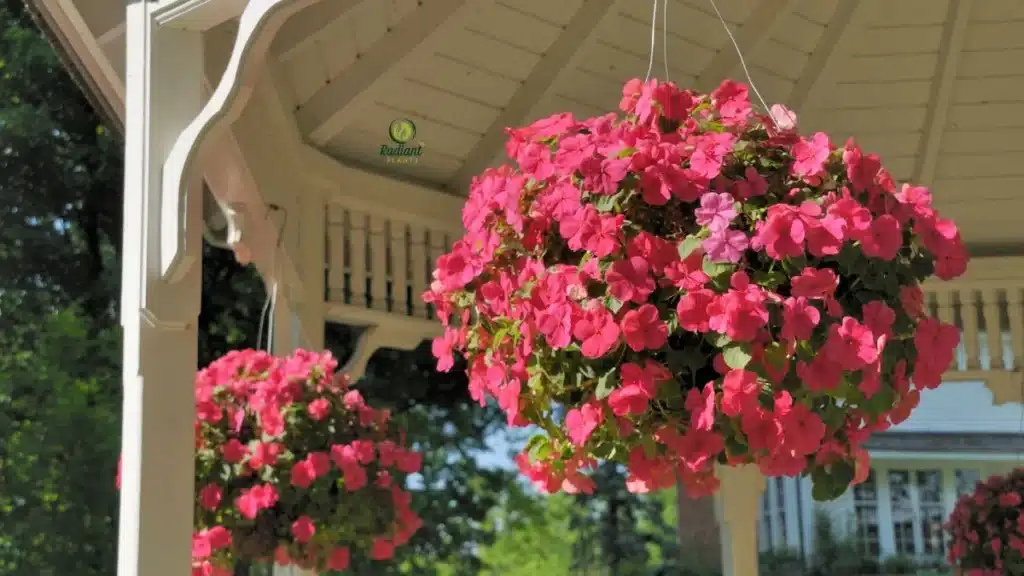
Choosing plants for hanging baskets starts with one non-negotiable factor: light exposure. Hanging baskets experience stronger sun, wind, and heat than ground plantings, which means plants that are mismatched to light conditions decline quickly—even with good watering and fertilizer.
Garden guidelines from the USDA and Canadian growing resources consistently show that light mismatch is the top cause of basket failure. Before picking plants, observe how many hours of direct sun your basket location receives each day.
Snippet-ready answer
Plants for hanging baskets should be chosen based on light exposure first. Full-sun baskets need plants that tolerate 6–8 hours of direct sun, while shade baskets perform best with plants adapted to filtered light or morning sun only. Matching plants to light prevents stress and early decline.
What are the best plants for hanging baskets in full sun?
Full sun typically means 6 to 8 hours of direct sunlight daily. South- and west-facing porches, balconies, and decks fall into this category. Plants used here must tolerate heat, drying winds, and intense light.
Snippet block
The best plants for hanging baskets in full sun are those that bloom continuously and tolerate heat. Petunias, calibrachoa, verbena, and sweet potato vine thrive with 6–8 hours of direct sun and maintain strong color when watered and fed regularly.
Top full-sun performers
- Petunias – Long bloom season, strong trailing habit, wide modern varieties are self-cleaning
- Calibrachoa (Million Bells) – Excellent for heat, compact roots, minimal deadheading
- Verbena – Airy texture, handles sun and brief drought well
- Sweet potato vine – Foliage spiller that adds contrast and tolerates heat
Care tips for full-sun baskets
- Water daily in summer; twice daily during heat waves
- Use slow-release fertilizer to support heavy blooming
- Trim lightly mid-season to refresh growth
University container trials show that sun-adapted plants last 30–40% longer in baskets when light exposure matches their requirements. For plant pairings that handle intense sun well, see the RadiantPlants internal guide:
“Full-Sun Container Plants That Don’t Burn Out.”
What are the best plants for hanging baskets in shade?
Shade baskets receive less than 4 hours of direct sun, often bright but indirect light. North-facing porches and covered patios fall into this category. Shade plants struggle in heat but excel when protected from harsh sun.
Snippet block
The best plants for hanging baskets in shade include fuchsia, trailing begonias, impatiens, and lobelia. These plants prefer bright, indirect light and cooler conditions, producing better foliage and flowers when protected from strong afternoon sun.
Top shade performers
- Fuchsia – Classic trailing flowers, prefers cool, shaded locations
- Trailing begonias – Heat-sensitive but excellent in bright shade
- Impatiens – Reliable color in low-light settings
- Lobelia – Fine texture, thrives in cooler shade environments
Care tips for shade baskets
- Avoid afternoon sun exposure
- Keep soil evenly moist, not soggy
- Improve airflow to prevent fungal issues
Canadian growing guidance from Agriculture and Agri-Food Canada emphasizes that shade plants perform best when protected from reflected heat and extreme temperature swings—common on balconies and walls.
Full Sun vs Shade Hanging Basket Plants
Feature | Full Sun Plants | Shade Plants |
|---|---|---|
Light needed | 6–8 hrs direct sun | Bright, indirect light |
Heat tolerance | High | Low to moderate |
Water needs | High | Moderate |
Common issues | Drying out | Fungal stress |
Examples | Petunia, calibrachoa | Fuchsia, begonia |
Plants for hanging baskets don’t fail because of poor care—they fail because they’re in the wrong light. Match plants to sun or shade first, and everything else becomes easier.
How Climate and USDA Zones Affect Hanging Basket Plants
Climate plays a bigger role in plants for hanging baskets than most gardeners expect. Because baskets are elevated, they heat up faster, cool down faster, and dry out more quickly than in-ground plantings. That means temperature swings—hot days, cool nights, and seasonal extremes—directly affect how long basket plants survive and how well they bloom.
To avoid early failure, plant choice should be aligned not only with sun exposure but also with USDA hardiness zones and regional climate patterns.
Snippet-ready answer
Plants for hanging baskets are strongly influenced by climate and USDA hardiness zones. Hot summers increase water stress, while cool nights shorten bloom life. Choosing plants adapted to your zone improves seasonal longevity, reduces stress, and keeps baskets healthy longer.
Why USDA Hardiness Zones matter for hanging baskets
The USDA Hardiness Zone system classifies regions by average annual minimum winter temperatures, but it also provides valuable insight into heat tolerance, seasonal timing, and plant resilience.
According to the USDA, plants outside their adapted zone experience higher stress—even in containers used for seasonal planting.
Key climate factors that affect hanging baskets:
- Heat stress
In Zones 7–10, baskets can overheat quickly. Dark containers and reflected heat from walls increase root-zone temperatures, which slows flowering and causes wilting. - Cold nights
In cooler Zones (3–6), spring and early summer nights can dip low enough to stall growth or damage heat-loving plants. - Seasonal longevity
Plants matched to local climate maintain bloom cycles longer and require fewer replacements mid-season.
Practical care step:
If you’re gardening near the edge of a plant’s tolerance range, choose varieties labeled as heat-tolerant or cold-tolerant, and delay planting until nighttime temperatures stabilize.
For a deeper explanation of zone-based container planting, see the RadiantPlants internal guide:
“How USDA Zones Change Container Gardening Results.”
Best hanging basket plants for hot summers
Hot summers—common across much of the southern US and parts of Canada during peak season—require heat-adapted plants that can tolerate high light, rapid drying, and warm roots.
Snippet block
The best plants for hanging baskets in hot summers are heat-tolerant annuals and drought-tolerant spillers. These plants maintain growth and color under high temperatures, recover quickly after watering, and resist stress caused by intense sun and warm root zones.
Heat-tolerant annuals
- Petunias (modern varieties)
- Calibrachoa
- Verbena
- Lantana
Drought-tolerant spillers
- Sweet potato vine
- Dichondra ‘Silver Falls’
- Trailing euphorbia
Care tips for hot climates
- Use light-colored baskets to reduce heat absorption
- Water early in the morning to prevent midday stress
- Trim lightly during peak heat to reduce plant load
University extension container trials show that heat-tolerant plants outperform traditional varieties in baskets by maintaining bloom density and foliage health during prolonged warm periods.
Climate considerations for Canadian gardeners
In Canada, temperature swings and frost dates matter more than prolonged heat. Guidance from Agriculture and Agri-Food Canada emphasizes timing and cold protection for container-grown plants.
Canadian-specific tips
- Delay planting until frost risk has passed
- Use cold-tolerant varieties in early-season baskets
- Protect baskets overnight during unexpected cold snaps
Plants that tolerate cool nights—such as begonias and lobelia—often perform better in Canadian regions than heat-loving species planted too early.
Climate and USDA zones directly shape how plants for hanging baskets perform. When plant choices match regional heat, cold, and seasonal patterns, baskets last longer, bloom better, and require far less intervention throughout the growing season.
Low-Maintenance Plants for Hanging Baskets (No Constant Care)
If you want plants for hanging baskets that look great without daily attention, the key is choosing varieties bred for containers and long bloom cycles. Low-maintenance basket plants tolerate limited root space, recover quickly after watering, and keep flowers coming with minimal pruning. These traits matter because hanging baskets dry out faster and are exposed to more heat and wind than ground plantings.
Snippet-ready answer
Low-maintenance plants for hanging baskets are those with self-cleaning blooms, compact root systems, and steady growth in containers. Plants like modern petunias, calibrachoa, begonias, and dichondra require less pruning and hold their shape longer, making them ideal for easy-care baskets.
Research-backed container trials used by nurseries across North America consistently show that plant genetics—not fertilizer schedules—drive long-term basket performance. Guidance aligned with container-growing standards from the USDA emphasizes selecting plants adapted to confined soil and frequent watering cycles.
What are the easiest plants for hanging baskets?
The easiest plants share two traits: self-cleaning flowers and stress tolerance. Self-cleaning plants naturally shed spent blooms, eliminating the need for deadheading. This single characteristic dramatically reduces maintenance time.
Snippet block
The easiest plants for hanging baskets are self-cleaning varieties like modern petunias, calibrachoa, trailing begonias, and dichondra ‘Silver Falls.’ These plants maintain shape, recover quickly after watering, and continue blooming without frequent pruning or deadheading.
Top low-maintenance performers
- Self-cleaning petunias – Continuous bloom, strong trailing habit, minimal trimming
- Calibrachoa (Million Bells) – Compact roots, heat-tolerant, no deadheading needed
- Trailing begonias – Reliable foliage and flowers in sun or shade
- Dichondra ‘Silver Falls’ – Foliage spiller, drought-tolerant, no flowers to manage
Practical care tips
- Use slow-release fertilizer at planting
- Water thoroughly but allow brief drying between waterings
- Trim lightly once mid-season if growth becomes leggy
For plant-by-plant performance notes, see the RadiantPlants internal resource:
“Best Self-Cleaning Container Plants for Busy Gardeners.”
Deadheading vs. self-cleaning: why it matters
Deadheading is the process of removing spent flowers to encourage new blooms. While effective, it requires time and consistency. Self-cleaning plants, by contrast, naturally drop old flowers and redirect energy into new growth.
Why self-cleaning plants win
- Fewer maintenance tasks
- More consistent appearance
- Better bloom continuity in containers
University extension container evaluations show that self-cleaning plants outperform traditional varieties in hanging baskets by maintaining visual quality with less labor over the growing season.
Low-Care vs High-Maintenance Hanging Basket Plants
Feature | Low-Maintenance Plants | High-Maintenance Plants |
|---|---|---|
Deadheading needed | Rarely or never | Frequently |
Root tolerance | High | Low |
Heat recovery | Fast | Slow |
Best for | Busy schedules | Hands-on gardeners |
Examples | Calibrachoa, begonia | Geraniums, some annuals |
Choosing easy-care baskets by location
- Full sun: self-cleaning petunias, calibrachoa, dichondra
- Part shade: trailing begonias, impatiens
- Hot climates: heat-tolerant petunias and foliage spillers
These recommendations align with container performance observations used in commercial nurseries and public garden trials throughout the US and Canada.
Low-maintenance plants for hanging baskets aren’t about shortcuts—they’re about smart selection. When you choose self-cleaning, container-adapted plants, baskets stay attractive with less effort, fewer replacements, and far more reliable results all season long.
Annuals vs Perennials for Hanging Baskets
When choosing plants for hanging baskets, one of the most common decisions is whether to use annuals or perennials. Both can work well—but they serve different goals. Annuals prioritize nonstop color for a single season, while perennials focus on long-term survival and repeat growth. Understanding the trade-offs helps you pick plants that match your climate, maintenance style, and expectations.
Snippet-ready answer
Annual plants are the most popular choice for hanging baskets because they bloom continuously and fill out quickly. Perennials can work in baskets, but they require climate-appropriate selection and often provide foliage interest rather than nonstop flowers.
Nursery recommendations across the US and Canada consistently favor annuals for hanging baskets because containers are exposed to more stress than in-ground plantings. Guidance aligned with container standards from the USDA emphasizes selecting plants that complete their life cycle within one growing season when grown above ground.
Pros and cons of annual plants
Annuals complete their life cycle in one season, which makes them ideal for baskets that are replanted each spring. They’re bred specifically for containers, heavy blooming, and fast establishment.
Advantages of annuals
- Long, uninterrupted bloom from spring to frost
- Predictable performance in containers
- Easy to replace or redesign each year
- Wide selection of trailing varieties
Common annuals used in hanging baskets
- Petunias
- Calibrachoa
- Verbena
- Impatiens
- Lobelia
Limitations
- Must be replanted every year
- Higher seasonal cost if baskets are replaced frequently
Snippet block
Annual plants are ideal for hanging baskets because they grow quickly, bloom heavily, and tolerate container conditions well. While they only last one season, they deliver the fullest appearance and most reliable color with minimal long-term commitment.
Practical care tip:
Annual baskets perform best with slow-release fertilizer at planting and consistent watering. Because they’re designed for seasonal growth, they respond quickly to trimming and feeding.
For Annual Plants for Shade, see the RadiantPlants internal guide:
“Annual Plants for Shade: 15 Stunning Picks That Thrive.”
When perennials work in hanging baskets
Perennials live for multiple years, but not all perennials are suited for containers—especially hanging baskets. When they are used successfully, it’s usually for foliage texture or seasonal interest, not nonstop blooms.
When perennials make sense
- Mild climates with minimal winter freeze
- Gardeners willing to overwinter baskets
- Designs focused on foliage rather than flowers
Perennials that may work in baskets
- Hardy sedums
- Heuchera (coral bells)
- Ivy (climate-dependent)
Limitations of perennials in baskets
- Slower growth and fewer flowers
- Winter survival depends on the region
- Roots are more vulnerable to freezing
In the US and Canada, overwintering baskets outdoors is rarely successful unless plants are rated hardy one to two zones colder than the local climate. Canadian growing guidance stresses that containers experience colder root temperatures than in-ground plantings, increasing winter loss.
Snippet block
Perennials can work in hanging baskets in mild climates or when overwintered indoors, but they rarely match the bloom power of annuals. Most gardeners use perennials for foliage texture rather than continuous flowering.
Annuals vs Perennials for Hanging Baskets
Feature | Annuals | Perennials |
|---|---|---|
Lifespan | One growing season | Multiple years |
Bloom duration | Long, continuous | Short or seasonal |
Container performance | Excellent | Variable |
Winter survival | Not applicable | Climate-dependent |
Best use | Color-focused baskets | Foliage or long-term designs |
For most gardeners, annuals are the best plants for hanging baskets because they deliver reliable color and strong performance in containers. Perennials can work in specific climates or design styles, but they require more planning and realistic expectations—especially in colder regions of the US and Canada.
How to Combine Plants Using the Thriller–Filler–Spiller Method
When designing plants for hanging baskets, structure matters as much as plant choice. The thriller–filler–spiller method is a professional container-design framework used by nurseries and public gardens across the US and Canada. It creates balance, fullness, and visual flow—without overcrowding or constant pruning.
Snippet-ready answer
The thriller–filler–spiller method combines one focal plant (thriller), supportive mid-level plants (fillers), and trailing plants (spillers). This structure creates balanced, full hanging baskets that look intentional, stay attractive longer, and are easier to maintain.
Extension-backed container design principles emphasize spacing and growth habit compatibility to reduce plant stress and improve longevity—key factors in elevated containers exposed to wind and heat.
What is the thriller–filler–spiller method?
The method assigns roles to plants based on growth habit—not species—so you can swap plants by climate, sun, or maintenance level without breaking the design.
1) Thriller (the focal point)
- Upright or mounding plant
- Adds height or bold color
- Used sparingly in hanging baskets (often compact)
Examples: compact grasses, geraniums, upright coleus
2) Filler (the body)
- Mounding plants that add density
- Fill gaps and support the thriller visually
Examples: petunias, calibrachoa, begonias
3) Spiller (the cascade)
- Trailing plants that flow over the edges
- Create movement and soften the basket outline
Examples: verbena, lobelia, sweet potato vine, dichondra
Snippet block
In hanging baskets, the thriller–filler–spiller method keeps plants from competing for space. Fillers provide fullness, spillers create flow, and a compact thriller adds structure—resulting in baskets that look polished without frequent reshaping.
Practical design tip:
Most hanging baskets need one filler + one spiller. Add a thriller only if the basket is large enough (12–14 inches or more).
Ready-made hanging basket recipes
These recipes follow the thriller–filler–spiller structure and can be adjusted by climate or availability. They’re designed for reliability, not trend-chasing.
Full Sun Basket
- Thriller: Upright geranium
- Filler: Self-cleaning petunia
- Spiller: Verbena
Care notes:
Water daily in summer; fertilize every 2–3 weeks.
Shade Balcony Basket
- Thriller: Compact coleus
- Filler: Trailing begonia
- Spiller: Lobelia
Care notes:
Protect from afternoon sun; keep soil evenly moist.
Low-Maintenance Basket
- Thriller: None (skip for simplicity)
- Filler: Calibrachoa
- Spiller: Dichondra ‘Silver Falls’
Care notes:
Minimal deadheading; trim lightly mid-season if needed.
Heat-Wave–Resistant Basket
- Thriller: Lantana (compact variety)
- Filler: Heat-tolerant petunia
- Spiller: Sweet potato vine
Care notes:
Morning watering; light pruning during extreme heat.
Snippet block
Hanging basket recipes work best when each plant has a clear role. Using fillers and spillers matched to sun and climate reduces overcrowding, improves airflow, and helps baskets stay attractive through heat waves and dry periods.
Why professionals use this method
The thriller–filler–spiller approach is standard in professional nursery design because it:
- Prevents root competition
- Improves airflow and light distribution
- Reduces mid-season decline
Extension-backed container guidelines—referenced by the USDA and university horticulture programs—support spacing by growth habit to maintain plant health in confined containers.
The thriller–filler–spiller method turns random planting into a repeatable system. When each plant has a role, hanging baskets stay balanced, fuller longer, and far easier to maintain—regardless of style or climate.
Soil, Watering, and Fertilizer Basics for Hanging Baskets
Healthy plants for hanging baskets depend more on soil quality, watering habits, and steady nutrition than on any single plant variety. Because baskets are exposed to sun and wind on all sides, they dry out faster and lose nutrients more quickly than garden beds. Getting these basics right prevents wilting, weak blooms, and mid-season decline.
Snippet-ready answer (40–60 words)
Plants for hanging baskets thrive when grown in a lightweight container soil, watered consistently, and fed regularly. Hanging baskets dry out faster than ground plantings, so proper watering frequency and slow, steady fertilization are essential for long-lasting blooms and healthy growth.
Guidance from university extension programs and the USDA consistently emphasizes that container-grown plants succeed when moisture and nutrients are managed proactively rather than reactively.
How often should you water hanging baskets?
Watering is the single most important daily task for hanging baskets. Because gravity pulls water through quickly and roots are exposed to heat and airflow, baskets need more frequent watering than most gardeners expect.
Snippet block (40–60 words)
Hanging baskets usually need watering once per day in mild weather and up to twice per day during hot or windy conditions. The goal is to keep soil evenly moist, never bone-dry or constantly soggy, to avoid root stress and flower drop.
General watering guidelines
- Water until excess drains from the bottom
- Check soil moisture daily in summer
- Adjust frequency based on weather, not the calendar
Warning signs
- Wilting at midday that recovers by evening = temporary heat stress
- Wilting that does not recover = underwatering
- Yellowing leaves + soggy soil = overwatering
Watering frequency by weather
Weather Conditions | Watering Frequency |
|---|---|
Cool, cloudy | Every 1–2 days |
Mild, sunny | Once daily |
Hot, dry, windy | Twice daily |
Extreme heat wave | Morning + late afternoon |
Extension-led container studies show that inconsistent watering causes more damage than occasional short dry periods. For deeper troubleshooting, see the RadiantPlants guide:
“Overwatering Symptoms: 6 Warning Signs to Know.”
Best soil and fertilizer for hanging baskets
The wrong soil can sabotage even the best plants. Garden soil is too dense for containers and restricts airflow to roots.
Best soil choice
- Lightweight container or potting mix
- Good drainage + moisture retention
- Often includes peat, bark, or coco coir
Soil tips
- Avoid garden soil or heavy compost
- Refresh the soil each season
- Ensure baskets have drainage holes
Fertilizer basics
Hanging baskets lose nutrients quickly due to frequent watering. Consistent feeding supports continuous blooms and foliage growth.
Snippet block
The best fertilizer for hanging baskets is a slow-release formula combined with occasional liquid feeding. Slow-release fertilizers provide steady nutrients, while liquid feeds support heavy flowering during peak growth periods.
Fertilizer options (optional)
- Slow-release granular fertilizer (mixed into soil at planting)
- Balanced liquid fertilizer every 2–3 weeks
Note: Product mentions should remain generic and optional. Choose reputable slow-release fertilizers available through Amazon US/CA or local garden centers—no specific brand is required for success.
Practical care checklist
- Use fresh container soil every season
- Water deeply, not lightly
- Feed consistently, not sporadically
- Adjust care during heat waves
These practices align with extension recommendations for container-grown plants and are widely used in professional nursery production.
Soil, water, and fertilizer form the foundation for successful plants for hanging baskets. When baskets are planted in lightweight soil, watered consistently, and fed steadily, plants stay fuller, bloom longer, and require far less emergency care throughout the growing season.
Common Hanging Basket Mistakes to Avoid
Most failures with plants for hanging baskets aren’t caused by bad luck or poor-quality plants. They come from a few repeat mistakes that stress roots, disrupt water balance, or force plants into light conditions they can’t tolerate. Understanding the why behind these issues—basic plant physiology—makes them easy to avoid.
Snippet-ready answer
The most common hanging basket mistakes are inconsistent watering and placing plants in the wrong light. Overwatering suffocates roots, underwatering causes rapid wilting, and light mismatch leads to weak growth. Correcting these basics prevents most hanging basket problems.
Guidance from university extension programs and the USDA consistently shows that container plants fail faster than in-ground plants because baskets amplify stress from water and light errors.
Too much water vs too little
Water problems account for more hanging basket failures than any other factor. The challenge isn’t just how much water, but how consistently it’s applied.
What happens with overwatering
- Roots sit in saturated soil
- Oxygen is displaced, leading to root suffocation
- Leaves yellow, growth slows, flowers drop
What happens with underwatering
- Fine roots dry out quickly
- Plants wilt rapidly and may not recover
- Buds abort and foliage scorches
Snippet block
Overwatering causes root suffocation, while underwatering dries out fine roots. Hanging baskets need evenly moist soil—not soggy and not bone-dry. Consistent watering supports healthy roots, which directly controls flowering and plant resilience.
Practical care steps
- Water deeply until the excess drains out
- Let the top inch of soil dry slightly before rewatering
- Increase frequency during heat or wind, not volume
Quick diagnostic tip
- Wilts that recover at night = heat stress
- Wilts that don’t recover = watering issue
For deeper troubleshooting, RadiantPlants covers this in detail in
“How to Get Rid of Aphids: 5 Mistakes to Avoid.”
Wrong plant in wrong light
Light mismatch is the second most common mistake—and one of the hardest to fix mid-season. Plants adapted to shade simply can’t handle full sun, and sun plants struggle in low light no matter how much care they receive.
What wrong light look like
- Shade plants in sun: scorched leaves, faded flowers, stunted growth
- Sun plants in shade: leggy stems, few blooms, weak color
Snippet block
Placing plants in the wrong light causes chronic stress. Shade plants burn in full sun, while sun plants stretch and stop blooming in low light. Matching plants to light exposure is essential for healthy hanging baskets.
Evidence-based fix
- Observe direct sun hours, not brightness
- Match plants to actual exposure (not label assumptions)
- Adjust placement before replacing plants
University extension guidance emphasizes that light stress compounds water stress, making recovery slower and reducing bloom life even when other care is correct.
Quick Do / Don’t Guide for Hanging Baskets
Do | Don’t |
|---|---|
Match plants to sun or shade | Guess light conditions |
Water consistently | Alternate flooding and drying |
Use container soil | Use garden soil |
Choose container-adapted plants | Force landscape plants into baskets |
Adjust care during heat waves | Follow a fixed schedule |
Why these mistakes matter (plant physiology basics)
Roots need oxygen, moisture balance, and stable temperatures. Hanging baskets exaggerate stress because they:
- Heats up faster
- Dry out faster
- Have limited root space
When water or light is wrong, roots fail first—and flowers follow shortly after.
Most hanging basket problems are preventable. When plants for hanging baskets receive consistent watering and the right light, they perform reliably. Fix these two fundamentals, and nearly every other issue becomes minor—or disappears entirely.
FAQs: Plants for Hanging Baskets
What are the best plants for hanging baskets?
The best plants for hanging baskets are trailing or cascading varieties that tolerate containers and bloom for long periods. Popular choices include petunias, calibrachoa, trailing begonias, verbena, and lobelia. These plants fill baskets quickly and stay attractive with basic care.
How often should you water hanging basket plants?
Most hanging basket plants need watering once a day in warm weather and twice a day during heat waves or strong winds. Baskets dry out faster than ground plantings, so consistent moisture—without soggy soil—is key to preventing drooping and flower loss.
Can hanging basket plants survive full sun all day?
Yes, but only sun-tolerant plants. Full-sun hanging basket plants like petunias, calibrachoa, verbena, and sweet potato vine handle 6–8 hours of direct sun. Shade plants placed in full sun often scorch, stop blooming, or decline quickly.
What are the easiest low-maintenance plants for hanging baskets?
Low-maintenance hanging basket plants are usually self-cleaning and container-adapted. Modern petunias, calibrachoa, trailing begonias, and dichondra require little pruning, recover quickly after watering, and keep their shape without constant attention.
Why do my hanging basket plants keep wilting?
Hanging basket plants usually wilt due to inconsistent watering or heat stress. Underwatering dries out fine roots, while overwatering suffocates them. Wilting can also happen when plants are placed in the wrong light, causing chronic stress even with good watering.
Should I use annuals or perennials in hanging baskets?
Annuals are usually better for hanging baskets because they grow fast and bloom nonstop for one season. Perennials can work in mild climates or for foliage interest, but most don’t flower as heavily and may not survive winter in baskets.
Choosing the right Plants for Hanging Baskets comes down to three basics: matching plants to light, selecting varieties suited to your climate, and using container-friendly care practices. When plants fit their environment, baskets stay fuller, bloom longer, and need far less troubleshooting. Simple design systems and consistent watering do more for success than chasing trends or overplanting. With the right choices, hanging baskets can look polished and healthy all season.
👉 Explore our next guide on RadiantPlants: “Decorating Window Sills with Plants: How to Style 5 Ways.”
👉 Get weekly planting ideas and basket inspiration by subscribing to our newsletter—or save this guide to Pinterest for easy reference when you plant or shop.